

















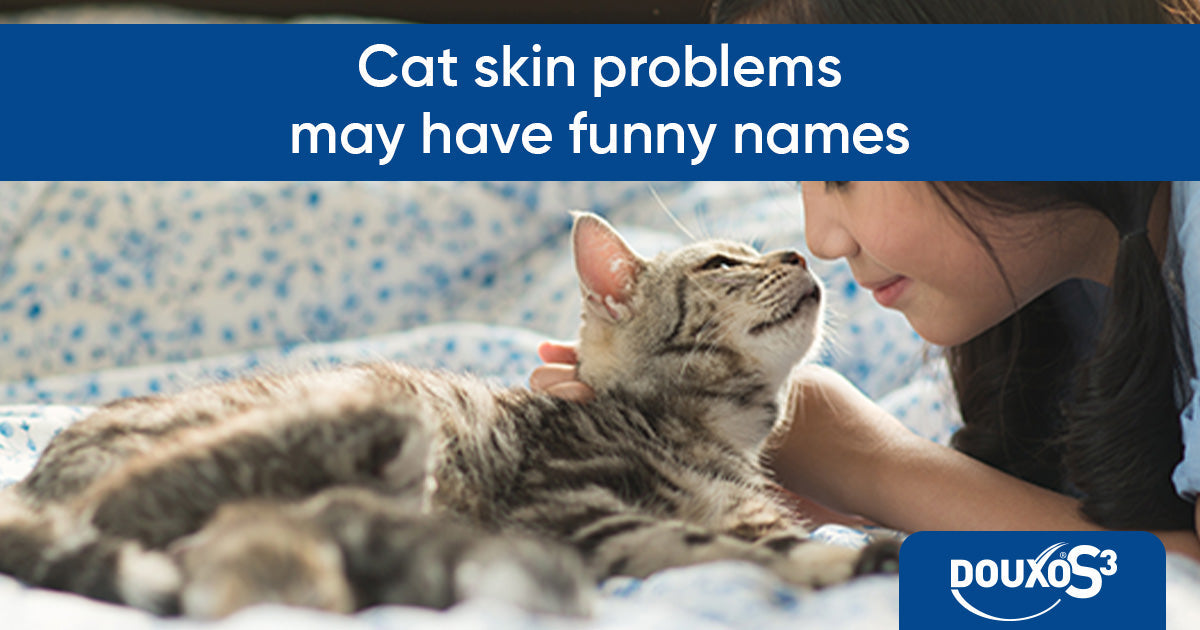
Cat skin problems may have funny names
Cat skin problems may have funny names
So, your vet has told you that your cat might have something called “eosinophilic granuloma complex”. It’s a strange name for an even stranger condition – so what on earth is it? What can be done about it? And how serious is it?
The world of the eosinophilic granuloma complex is a complicated one between the cats with skin problems! But there is absolutely no doubt that it is a fascinating one. This condition only affects felines, and in this article, we will explore what it is, how to recognise it and how it can be managed.
What is eosinophilic granuloma complex?
‘Eosinophilic granuloma complex’ (EGC) is just a fancy term used to classify and describe three forms of skin lesions in cats that share a number of key characteristics and may appear as a consequence of various diseases. It is important to understand that it is not a diagnosis but a clinical sign, like fever may be just a sign of an infection, for instance. These three forms are called eosinophilic plaques, eosinophilic granulomas, and indolent ulcers, and there are differences between the different types.
It sounds weird, doesn’t it? but it really is a common diagnosis!
Indolent ulcers
These appear, as you might expect with ulcers, on the upper lips. They range from tiny, almost unnoticeable ulcers to ones large enough to disfigure the lips. These larger ulcers are much easier for owners to recognise. In this context, the word “indolent” actually means “painless” (rather than lazy). We don’t know for sure if they are completely pain free, but certainly cats don’t seem to be bothered by them, so the term has stuck.
Eosinophilic granulomas
These lesions typically consist of small, raised and sometimes very itchy patches of skin. They most commonly develop in the mouth and are also often seen on the backs of the thighs and on the chin. When this happens, they are referred to as “linear granuloma” and “greasy chin”, because of their common appearance! However, they can appear on the paw pads too, or even elsewhere on the body.
Eosinophilic plaques are a little more unique
They are areas of hairless, patchy, often very itchy, and painful lesions that can develop anywhere, being more commonly found along the tummy, legs, face and neck. Eosinophilic plaques can often look discoloured – red, yellow, or even orangish in colour – and are more inflamed and angry than the other types. This is because your cat can often lick or bite these lesions due to their more easily accessible location.
If you notice any of the above lesions in your cat, always seek veterinary advice.
Why do they happen?
Most people’s first question is what causes these skin problems to occur. Quite simply, the underlying cause is usually impossible to identify. There are some theories, and studies suggest that eosinophilic granuloma complexes are part of an allergic reaction, especially in recurring cases. Feline allergic disease, or atopic dermatitis, is the second most common allergy in cats after flea allergy dermatitis. It typically occurs when part of the cat’s immune system goes into overdrive and overreacts to a harmless substance in the environment (the allergen). Some studies also suggest that EGC may be an inherited condition.
You can learn more about this here, in our blog on atopic dermatitis {LINK}.
How do vets diagnose eosinophilic granulomas?
The lesions can sometimes be recognised based just on their appearance – many have a unique and characteristic appearance. To obtain a definitive diagnosis, though, your vet can take samples from the lesions with a fine needle. These can then be studied under the microscope to see if they contain the characteristic eosinophilic cells. If this is inconclusive, then your vet can perform a biopsy of the lesion under anaesthetic. The tissue removed is then sent to the laboratory for full assessment by an expert histopathologist. A biopsy is the only way to accurately determine the lesion’s nature and to 100% diagnose EGC. Biopsies also allow cancers to be ruled in or out as an underlying cause, as some cancerous growths can look very similar.
How can eosinophilic granulomas be treated?
There are several modes of treatment, as you would expect of a condition with more than one cause - and different cats will require a different mix of approaches. Your vet will be able to help you find the most suitable course of treatment for your cat as an individual with those skin problems.
Symptomatic treatments
The most common treatment approach is to provide relief from itching and decrease the inflammation. As a result, a common treatment for controlling the symptoms of eosinophilic granuloma complex is steroid-based medicines. These can be administered by your vet by injection, or at home as tablets, depending on which route is better tolerated by your cat. For more aggressive lesions, cats who are difficult to pill, or with cats who cannot tolerate steroids, cyclosporine is an alternative option that damps down the overactive immune response. Sometimes, the skin lesions can also become infected, which may mean your vet prescribes specific medications or topical products to eliminate the bacteria.
Reducing the triggers
Of course, if the underlying cause of EGC is identified, e.g., a parasite or a known food, the treatment can be tailored to remove or, more likely, limit exposure to this cause. But most cats that suffer from EGC will need to undergo a full set of tests. This is part of the diagnostic plan for skin problems in cats, and usually the only way to manage in the long-term. The diagnostic and management process will probably include a flea and worm schedule for your cat, even if you cannot see evidence of parasites. Additionally, special foods such as ‘hypoallergenic’ diets can be fed to those cats with a suspected underlying food allergy (even if it has eaten the same food for a long time), and specific test to identify environmental allergens, may be requested by your vet.
Topical care
The final management strategy to discuss is topical treatments. Most cat owners shy away from bathing their cat due to the stress they assume it will create both for themselves and for their feline friend. But this is unnecessary, as some beneficial topical products are now available that can substantially aid with managing EGC cases.
DOUXO® S3 CALM is designed to soothe itchy, irritated and sensitive skin. It also improves skin hydration and acts as a barrier against allergens. This product comes in a variety of forms, and your vet will assist you in deciding which type of product is best suited to your cat. For those sensitive cats who resent bathing, don’t worry, there is an alternative! You could apply the leave-on mousse or use the pads on the affected skin areas instead.
Another useful topical product is DOUXO® S3 PYO, which is tailored more specifically towards those cats with infected skin lesions. This product has a gentle antibacterial and anti-yeast effect. It also comes in a few forms, including shampoo and pads. In these cases, pads are especially convenient as they are as easy to use as to stroke your cat! This provides you with a range of options so that you can consider which will be better tolerated by your cat.
Will my cat recover?
Cats with eosinophilic granuloma complexes have a good prognosis, although it is important to be aware that the condition can reoccur in some patients. Most cases respond well to treatment, but in those recurring cases, consistent and lifelong treatment will usually keep it well managed and under control. It is better for your cat to try and maintain the condition under permanent control, rather than treating frequent flare-ups as and when.
To conclude, eosinophilic granuloma complex is a common clinical sign we see in felines Management can vary from case to case, and a combination of treatment strategies is often required.
We recommend DOUXO® S3 PYO and DOUXO® S3 CALM